Longevity
Your biology, analysed in depth.
One blood test. One video call with your doctor. Find out where you stand, your estimated biological age, and the three changes that matter most for you.
- ●Every result explained in plain English
- ●A video consult with your doctor, and a written plan with six-month targets
- ●S$599, all of the above included. For patients in Singapore.
Biological age is estimated with clinical PhenoAge, from your blood results. It's an estimate, not a diagnosis.
More numbers aren't the goal.
You may already have reports, scores and logs. The hard part is knowing what they mean together: what needs attention, what can wait, and what you don't need at all.
Every data point. One clear plan.
100+ blood and urine markers, read together with your wearable data and how you eat, move and sleep. AI finds the patterns. Your doctor checks every one and gives you three priorities, each with a target you can track.
A study of one: you.
Generic health plans rely on averages. Yours is built on your own biology. Track your progress in our app between visits, and re-test at six months. We double down on what works, recalibrate what doesn't, and build a baseline designed to last.
How it works
1
Book and pay.
About a minute online. Add any extra tests you want.
2
Tell us about you.
A short questionnaire. Add your wearable data and past reports if you have them.
3
Have your blood test.
Fast overnight, then one visit to a collection centre run by our partner lab.
4
Meet your doctor.
When your results are in, we send you a link to book your video consult. You leave with your report and a plan you've agreed together.
Your Longevity Report
What you didn't know. What to do about it.
Not "sleep more, move more". One page that shows what your results say, what you didn't know, and what to do about it this week.
- Where you stand, at a glanceYour strengths, and what to watch.
- What we foundPatterns that only show when your blood, wearable and lifestyle data are read together.
- Three prioritiesBuilt around your actual week, not an ideal one.
- Targets with numbersSo you, and your doctor, can see what moved.
Your full results follow, in plain English, with the lab's ranges and your doctor's targets side by side. In range isn't the same as on target.
Sample report for an invented patient, not a real result.
Your Longevity Report · page one
Alex Tan, 46
Strengths
- ✓Kidney and liver results within range
- ✓Blood count within range
- ✓About 14,000 steps a day at weekends, from your wearable
Watch
- !ApoB 1.05 g/L: within the lab range, above your target
- !Lp(a) 142 nmol/L: raised, and inherited
- !About 5 h 50 min of sleep on work nights
What we found
Your exercise is a strength. Your cholesterol particles still need attention.
You run twice most weekends. But your ApoB is 1.05 g/L, and your Lp(a), which is inherited and had never been tested, is 142 nmol/L: raised. Exercise alone shouldn't be expected to fix this. Your brothers, sisters and children may want to check their Lp(a) too.
Your glucose is in range. Your insulin may suggest reduced insulin sensitivity.
Fasting glucose 5.2 mmol/L, fasting insulin 14 µIU/mL (calculated HOMA-IR 3.2), read alongside your HbA1c and waist. Possible link, to discuss: about 5 h 50 min of sleep Monday to Thursday. Short sleep can reduce insulin sensitivity. It's one possible contributor, not a proven cause.
Your weekends are strong. Your workdays aren't.
About 14,000 steps on Saturdays and Sundays, about 4,000 on office days, and no strength training logged. Your weekly average of about 6,900 hides the gap.
Your three priorities
- 1EatBuild your plan with your doctor: oats or beans daily, less saturated fat, and a discussion about whether cholesterol-lowering medication is right for you.
- 2SleepAt least 7 hours on work nights. Your bedtime is set from the time you need to wake, then checked against your wearable.
- 3MoveTwo 25-minute strength sessions before work, plus a 10-minute walk after lunch on office days.
Your six-month targets
ApoB, agreed with your doctor
1.05 → 0.80 g/L
Work-night sleep
5 h 50 → 7 h
Strength sessions
0 → 2 a week
Insulin, HbA1c and ApoB are rechecked at six months, if you choose the recheck.
49
Estimated clinical PhenoAge (your age: 46). A blood-based risk estimate, not a measure of lifespan or a diagnosis.
Dr Shameer KassimReviewed and signed
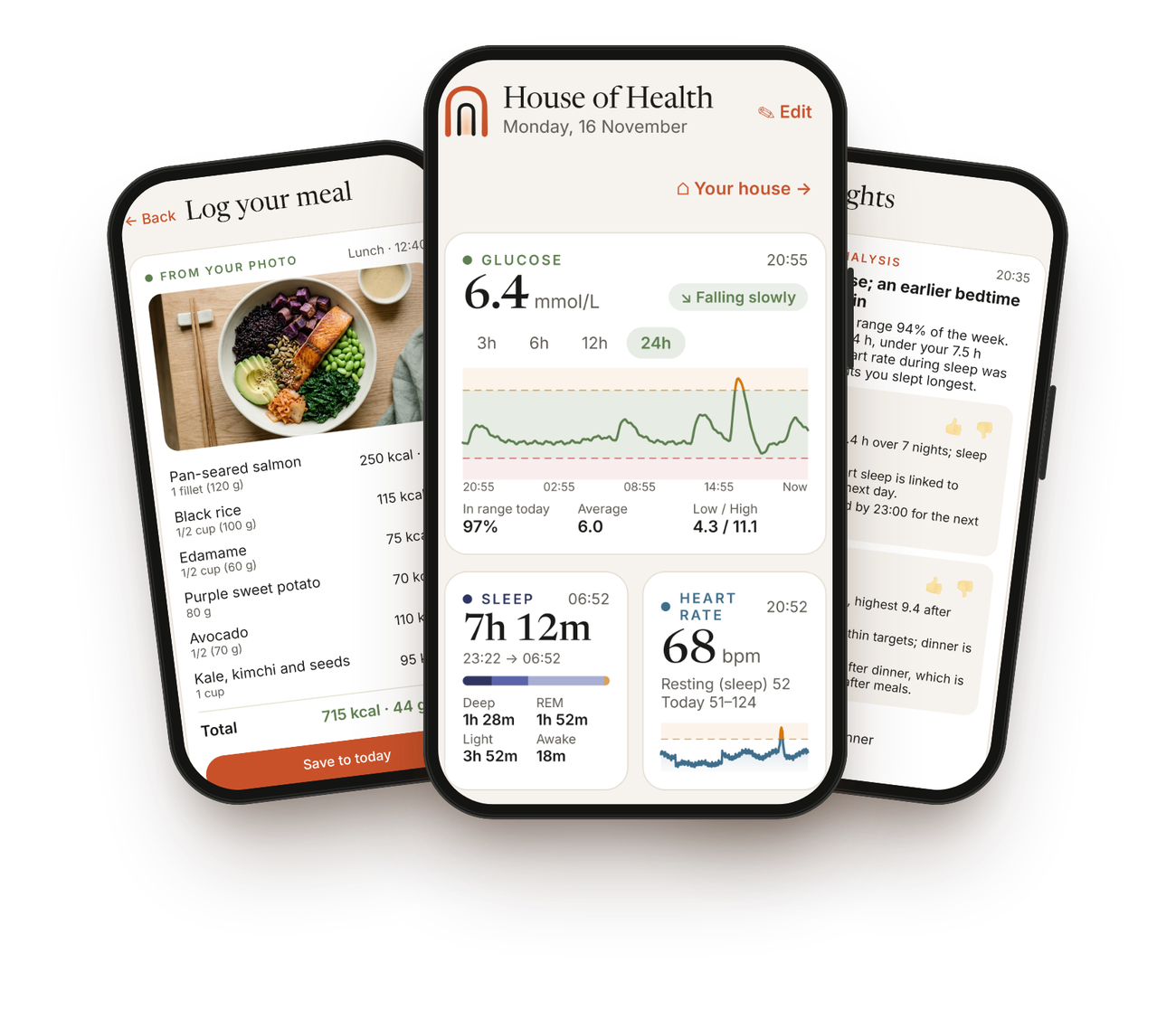
Between visits · the House of Health app
Your biology, decoded daily.
- ●Your wearable data, meals and workouts in one place
- ●Daily insights: what we see, why it matters, one thing to try
- ●Share it with your doctor before your next consult
For Android phones. Not yet on iPhone. Optional: your targets are checked on your blood results either way.
What we test
100+ markers, explained.
From blood and urine, in one visit, after an overnight fast. Tap a group to see each test and what it checks.
Clinical PhenoAge
Go beyond your birth date. Discover your biological age estimate through a blood-based lens on metabolic health, inflammation and physiological function. Included in your Longevity Assessment, with a one-to-one doctor review to turn insight into a personalised health plan. It's an estimate, not a diagnosis.
Blood sugar and metabolic+
- Fasting glucose
- Your blood sugar at the time of testing.
- HbA1c
- Your average blood sugar over the past two to three months.
- Fasting insulin
- The amount of insulin your body produces while fasting.
- HOMA-IR (calculated)
- An estimate of how well your body responds to insulin.
- Uric acid
- A substance that can contribute to gout and some kidney stones when raised.
Lipids and cardiovascular+
- Total cholesterol
- Your overall cholesterol level.
- LDL cholesterol
- Cholesterol that can contribute to fatty deposits in your arteries.
- HDL cholesterol
- Cholesterol carried by particles that help move it back to the liver.
- Triglycerides
- A type of fat in your blood.
- Cholesterol/HDL ratio
- Your total cholesterol compared with your HDL, another way to look at heart risk.
- HDL/LDL ratio (calculated)
- The balance between these two cholesterol measurements.
- Apolipoprotein B
- Helps assess the number of particles that can contribute to artery disease.
- Apolipoprotein A1
- The main protein in HDL particles.
- ApoB/ApoA1 ratio
- Another way to assess your cholesterol-related risk.
- Lipoprotein(a)
- An inherited risk factor for heart disease and stroke.
- hs-CRP
- Low levels of inflammation that may contribute to heart-risk assessment.
- NT-proBNP
- A marker that can rise when the heart is under strain.
- Homocysteine
- A substance influenced by certain vitamins, kidney function and other factors.
- Fibrinogen
- A protein that helps your blood clot. It also rises with inflammation.
Inflammation+
hs-CRP is listed under lipids and cardiovascular.
- ESR
- A general measure of inflammation in the body.
Full blood count+
- Haemoglobin
- Your blood's ability to carry oxygen.
- Red cell count and haematocrit
- The amount of red blood cells in your blood.
- MCV, MCH, MCHC and RDW
- The size and characteristics of your red blood cells, helping assess anaemia.
- White cell count and 5-part differential
- The number and types of immune cells in your blood, as percentages and absolute counts.
- Platelets
- Blood cells that help stop bleeding.
- Peripheral blood film
- A lab specialist looks at your blood cells under a microscope.
- Blood group
- Your ABO and Rhesus blood type, which is useful to have on record.
Iron studies+
- Ferritin
- Your stored iron.
- Serum iron
- Iron circulating in your blood.
- Transferrin and TIBC
- Your blood's ability to carry iron.
- Transferrin saturation
- How much of that iron-carrying capacity is being used.
Vitamins and minerals+
- Vitamin B12
- A vitamin needed for healthy nerves and blood cells.
- Folate
- A vitamin needed to make healthy cells.
- Vitamin D (25-OH)
- A vitamin important for bone and muscle health.
- Zinc
- A mineral involved in immunity and healing.
- Magnesium
- A mineral important for muscles and nerves.
- Calcium
- A mineral important for bones, muscles and nerves.
- Adjusted calcium
- Your calcium level corrected for your blood protein (albumin), so the reading is more accurate.
- Phosphate
- A mineral involved in bone health and energy use.
Liver and proteins+
- ALT and AST
- Enzymes that can rise with liver injury.
- ALP and GGT
- Enzymes that help assess the liver and bile ducts.
- Total bilirubin
- How your body processes a substance produced when old red blood cells break down.
- Total protein, albumin and globulin
- Important proteins in your blood.
- Albumin/globulin ratio
- The balance between the main groups of blood proteins.
- LDH
- An enzyme that can rise with injury to different body tissues.
Kidney and electrolytes+
- Creatinine and eGFR
- How well your kidneys filter waste.
- Urea
- A waste product normally removed by the kidneys.
- Sodium, potassium and chloride
- Minerals involved in fluid balance, muscle function and heart rhythm.
- Bicarbonate
- Your body's acid–base balance.
- Urine microalbumin, urine creatinine and albumin/creatinine ratio
- Looks for small amounts of protein leaking into your urine, an early sign of kidney strain that is often linked to blood pressure and blood sugar.
Thyroid+
- TSH
- The signal that tells your thyroid how hard to work.
- Free T4 and free T3
- Thyroid hormones involved in metabolism and many body functions.
Hepatitis+
- Hepatitis A antibody (total)
- Helps assess previous exposure or immunity.
- Hepatitis B surface antigen
- Looks for evidence of a current hepatitis B infection.
- Hepatitis B surface antibody
- Helps assess immunity to hepatitis B.
Tumour markers+
- CEA
- Can be raised in some bowel and other cancers, and also in smokers and in some conditions that aren't cancer.
- AFP
- Can be raised in some liver cancers. It is most useful for people with hepatitis B or liver scarring.
- CA 19-9
- Can be raised in some cancers of the pancreas and bile ducts, and also in conditions that aren't cancer.
- EBV IgA
- An antibody to the Epstein–Barr virus, used to help check for nasopharyngeal (nose and throat) cancer. This cancer is more common in Singapore than in many other countries.
- PSA (men)
- A prostate marker that may need further assessment if raised. It does not diagnose cancer.
- CA 125 (women)
- Can be raised in some ovarian cancers, and also with periods, endometriosis or fibroids.
- CA 15-3 (women)
- Can be raised in some breast cancers. It doesn't replace a mammogram.
Men's hormones+
- Total testosterone
- A hormone involved in sexual function, muscle and bone health.
- SHBG
- A protein that carries sex hormones in the blood, which affects how much your body can use.
- Free and bioavailable testosterone (calculated)
- The share of your testosterone that your body can use, calculated from your results.
- Estradiol
- A form of oestrogen. Men make small amounts, which help keep bones healthy.
- LH and FSH
- Signals from the pituitary gland in the brain that control the testes.
- Prolactin
- A pituitary hormone. High levels can affect fertility and libido.
Women's hormones+
- Estradiol
- The main form of oestrogen, read alongside your menstrual cycle or menopause.
- Progesterone
- A hormone that rises after ovulation, read alongside the timing of your cycle.
- Testosterone
- Women make small amounts. It plays a part in energy, mood and libido.
- SHBG
- A protein that carries sex hormones in the blood, which affects how much your body can use.
- LH and FSH
- Signals from the pituitary gland in the brain that control the ovaries.
- Prolactin
- A pituitary hormone. High levels can affect periods, fertility and libido.
Urine+
- Full urinalysis with microscopy
- Checks your urine for blood, protein, sugar, cells and signs of infection.
Your doctor goes through every result with you. A single result outside the range doesn't mean something is wrong.

Your doctor
Dr Shameer Kassim
MBBS (NUS) · Founder and Director, House of Health
Dr Shameer has spent almost 20 years in emergency departments and family clinics across Singapore, New Zealand and Asia, seeing the late consequences of preventable disease. He now focuses on the other end of the spectrum. Having completed courses with the Geneva College of Longevity Science, the American College of Lifestyle Medicine and the American Academy of Sleep Medicine, he leads longevity and lifestyle protocols at House of Health.
Price
Longevity Assessment.
One assessment, with your doctor consult included. Add any of the tests below when you book.
Longevity Assessment
S$599
- ✓Health and lifestyle questionnaire
- ✓Review of your past reports, and your wearable data if you have it
- ✓100+ markers from blood and urine, including clinical PhenoAge
- ✓AI-assisted analysis, reviewed and signed by your doctor
- ✓A video consult with your doctor, with a dietitian when your doctor adds one
- ✓A one-page summary, a written plan and your six-month targets
- ✓Referral to a specialist, if needed
Optional six-month recheck: S$499. The same panel, an updated PhenoAge, and your results compared with your first set and your targets, with a doctor consult. It's your choice.
Not included: specialist fees, extra tests, the add-ons below, medicines, and any overseas care or travel.
Book your Longevity Assessment →Add-ons
Optional extra tests. Add any of them when you book your Longevity Assessment, or with your six-month recheck.
LucenceINSIGHT Core
A blood test that screens for signs of six cancers: thyroid, breast, liver, lung, pancreatic and colorectal.
Blood testS$599
LucenceINSIGHT Me
Screens for the six Core cancers, plus three cancer types you select.
Blood testS$1,199
AMILI Gut Microbiome Assessment
Stool-based profiling of your gut bacteria: composition and diversity, microbiome-age and functional scores, with personalised dietary recommendations.
Home stool kitS$449
VO₂ max assessment
Measures your oxygen use during graded exercise: a direct measure of cardiorespiratory fitness.
At a testing facilityS$249
DEXA body composition
Total and regional body fat, lean mass and its distribution, and bone mineral content, with a visceral-fat estimate where the equipment supports it.
Scan at a testing facilityS$299
VO₂ max + DEXA
Both assessments together.
At a testing facilityS$449
LucenceINSIGHT is a blood test that screens for signs of cancer. It doesn't replace recommended screening such as mammograms or colonoscopy, and a positive result needs follow-up tests.
Questions
Before you book.
Do I need to fast?+
Yes, for about 8 to 10 hours before your blood test. Water is fine. We'll send full instructions with your lab form.
Where do I have my blood test?+
At a collection centre run by our partner lab, in Singapore. We'll include the details with your lab form.
Do I need a wearable?+
No. Your blood results and lifestyle assessment give your doctor plenty to work with, and your targets are set and checked on your blood results. Wearable data adds detail if you already have it.
How is AI used?+
AI helps us sort your data and draft notes for your doctor. Your details are removed before anything is sent to it. Your doctor checks every finding and makes every decision. We ask for your consent when your results are ready. If you'd rather not, your doctor does the analysis without it.
What is clinical PhenoAge?+
An estimate of your biological age, calculated from nine routine blood results (including albumin, creatinine, glucose, hs-CRP and parts of your blood count) and your age. It's an estimate, not a diagnosis, and it's only available with the Longevity blood test.
What isn't included?+
Specialist fees, extra tests, the add-ons, medicines, and any overseas care or travel.
S$599 · doctor consult included
Optional six-month recheck S$499
Book your Longevity Assessment →Clinical PhenoAge is an estimate, not a diagnosis.